Stock trading platform speeds: what our live tests revealed
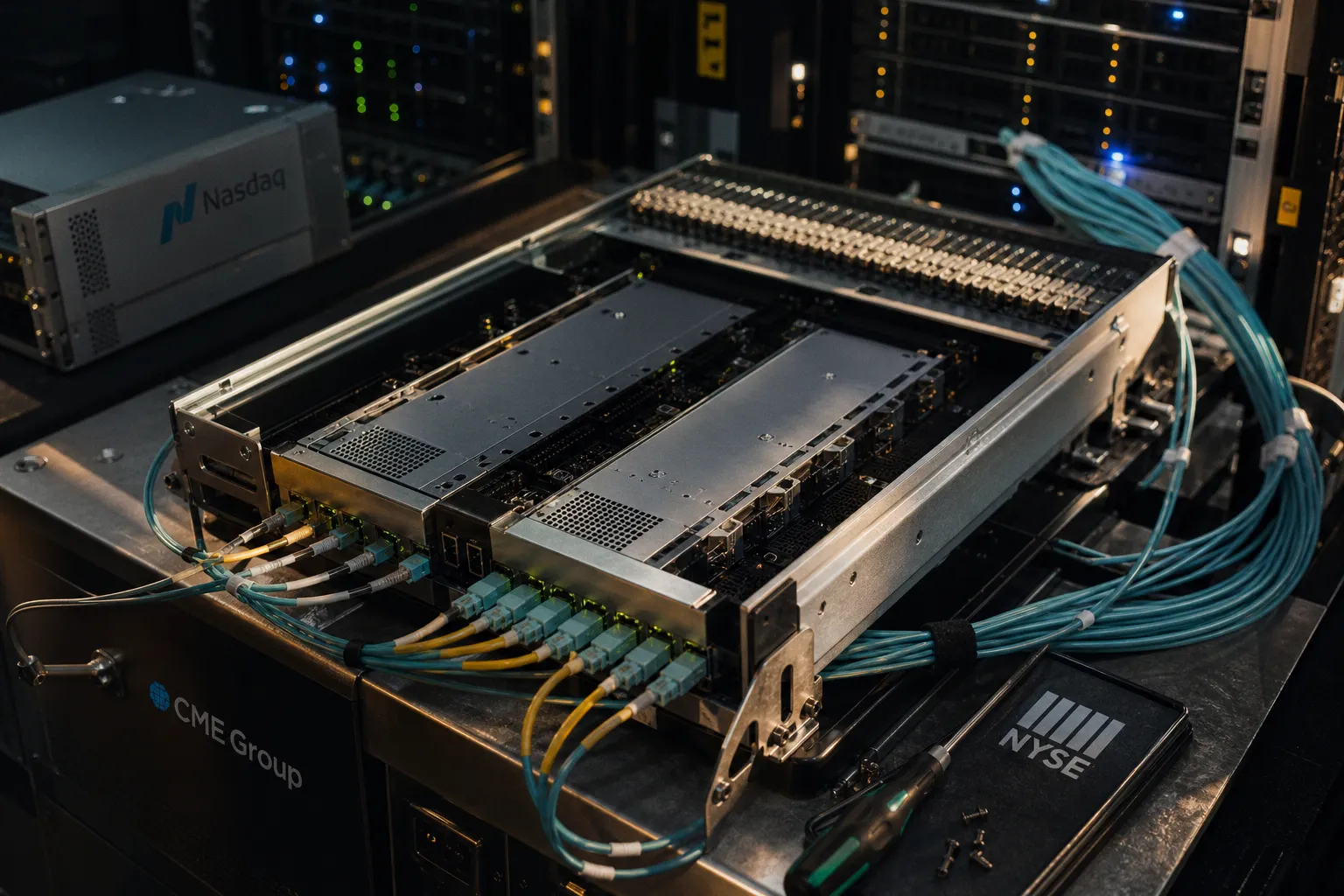
In our live testing of stock trading platform behavior, the main finding was not that one app felt snappier than another. It was that “speed” splits into several different clocks. The screen has one clock. The broker has another. The market maker or exchange has a third. And during volatility, the price you thought you were hitting can move before the back end has finished the job.
That distinction matters most when investors are least prepared for it: around earnings gaps, Fed days, meme-stock squeezes, ETF rebalances, opening auctions, and broad selloffs when spreads widen. In quiet markets, a slow chain can look competent. Under stress, the same chain starts to show its duration risk — not in the bond sense of years to maturity, but in the practical sense of exposure to time while price is moving against you.
The anatomy of a trade: from app tap to actual execution
A retail stock order begins with a clean interface and ends in a messy market structure. That is the first thing our brokerage platform test reinforced. The tap is not the trade. It is only the instruction.
A simplified market order flow usually looks like this:
1. You submit the order in the app or web platform.
The interface records your intent: ticker, size, side, order type, account, time in force, and sometimes extended-hours eligibility. This stage can feel instant even if nothing has reached a market center yet.
2. The broker’s systems validate the order.
The platform checks buying power, margin requirements, account restrictions, symbol status, order limits, and whether the security is eligible for the trading session. A clean cash account order in a large-cap stock is easy. A margin account order in a volatile name near a trading halt is not the same animal.
3. The broker routes the order.
This is where retail trading platform latency becomes less visible and more important. The broker may route to a wholesale market maker, an exchange, an alternative trading system, or another venue depending on its routing logic, order type, and commercial arrangements.
4. The venue or market maker attempts execution.
A market order seeks the best available price at the time it is received. But “best available” is not static. The National Best Bid and Offer can change quickly, especially when liquidity is thin or the tape is moving.
5. The execution report returns to the broker and then to you.
Your app displays the fill, partial fill, rejection, or pending status. The app may be fast at refreshing the confirmation screen. That does not prove the order was fast in market terms.
The key problem is that retail investors often judge stock trading platform performance by the first and last steps: the tap and the confirmation. The true economic result lives in the middle.
A fast app can still be a slow trade if the route, queue, and fill quality work against you.
In our testing, the most consistent pattern was variation. Some orders appeared to move through the chain quickly in calm, liquid names. Others sat just long enough to remind us that milliseconds are not a marketing flourish; they are the unit in which market exposure accumulates. High-frequency firms operate closer to microseconds. Retail platforms, burdened by consumer internet connections, app-side processing, broker controls, and routing pathways, usually live on a slower clock.
That slower clock does not automatically make a platform bad. Retail investors do not need hedge-fund colocation to buy 20 shares of a diversified ETF. But they do need to know whether the platform is masking execution risk with a polished interface.
What our live tests could and could not prove
A clean test of trading platform execution speed is harder than it looks. Anyone who claims a retail app is “the fastest” without a controlled technical audit is leaning too far over the skis.
We did not treat the stopwatch on a phone as gospel. We looked at the observable experience: order acknowledgment, order status changes, fill confirmations, behavior during calmer and more active market windows, and the gap between interface responsiveness and execution reality. We also compared that experience with the public execution-quality framework investors can actually inspect, particularly SEC Rule 605 reports.
There are limits. Individual brokers do not publish fully standardized, app-level millisecond benchmarks that let investors compare Robinhood, Fidelity, Schwab, Interactive Brokers, E*TRADE, or other platforms on identical terms across the same orders, same network, same timestamp, same venues, and same market conditions. Routing algorithms are proprietary. The exact contribution of zero-commission economics to routing choices is not visible trade by trade.
So the right conclusion is not a trophy ceremony. It is a risk map.
| What investors see | What it may actually measure | Why it matters |
|---|---|---|
| App opens quickly | Front-end responsiveness | Useful for usability, weak evidence of execution quality |
| Order button responds instantly | Local/app acknowledgment | Does not prove the order reached a venue |
| Fill confirmation arrives fast | End-to-end reporting speed | Helpful, but still needs price-quality context |
| Price improvement claim | Execution versus quoted price benchmark | More meaningful when paired with order type and share size |
| Rule 605 speed data | Market-center execution statistics | Useful, though not the same as your exact app session |
| Slippage on market order | Price movement between intent and fill | Critical during volatility and wide spreads |
The sober way to evaluate a platform is to separate convenience from execution. A beautiful mobile interface reduces friction. It does not repeal market structure.
Decoding SEC Rule 605 without getting lost in the plumbing
SEC Rule 605 is one of the few public windows into execution quality. It requires market centers to publish monthly electronic reports with statistics on execution speed, price improvement, and related measures. The rule was amended in 2023, reflecting the regulator’s continued pressure on execution transparency.
Investors should not pretend these reports are bedtime reading. They are dry, mechanical, and easy to misread. But they are more useful than app-store reviews, which tend to reward color schemes and login speed.
The figures worth watching include:
- Execution speed: often reported in time buckets. This gives a sense of how quickly orders are executed after receipt by the market center, not necessarily how quickly your phone handed the order to the broker.
- Price improvement: commonly expressed in cents per share. This shows whether an order received a better price than the quoted benchmark, but small improvements can be overwhelmed by bad timing in a fast market.
- Fill rates: the percentage of orders executed at or better than the National Best Bid and Offer. A high fill rate is encouraging, though it should be read alongside order size, security type, and volatility.
- Order type segmentation: market orders, marketable limit orders, and other categories behave differently. Mixing them together produces false comfort.
- Covered order size: a 100-share order in a liquid mega-cap is not a 2,000-share order in a thinly traded small-cap. Liquidity is the collateral behind speed.
Rule 605 does not solve the entire puzzle. It is more like a credit spread than a credit rating: a market signal, not a full diagnosis. It tells you something about compensation for risk, but it does not tell you every hidden covenant in the structure.
The mistake is to read execution speed in isolation. In fixed income, a high yield means very little without duration, convexity, inflation, taxes, and default probability. In equity execution, a fast fill means very little without spread, price improvement, venue quality, order type, and market condition.
A platform can execute quickly and still give mediocre economics if the spread is wide. Another can be marginally slower but deliver better price improvement in normal conditions. The tradeoff is not always speed versus slowness. It is speed versus price certainty, routing economics, and resilience under stress.
Payment for order flow: the quiet incentive behind the route
Payment for Order Flow, or PFOF, sits at the center of the modern zero-commission brokerage model. The basic structure is well known: many retail brokers route customer orders to wholesale market makers, which may compensate the broker for that order flow. The market maker executes the trade, often claiming price improvement relative to public quotes.
This arrangement is not automatically harmful. Retail orders are often small, uninformed in the institutional sense, and attractive to wholesalers. That can produce quick executions and modest price improvement in ordinary conditions. But it introduces an incentive structure investors should not wave away.
The broker’s routing decision may reflect multiple objectives: execution quality, price improvement, speed, fill probability, operational reliability, and economics. The exact routing algorithm is proprietary. That is the point. You cannot inspect it the way you can inspect a Treasury yield curve.
The upside case for PFOF is straightforward:
- Retail investors avoid explicit stock commissions on many platforms.
- Wholesalers may execute small orders rapidly in highly liquid stocks.
- Price improvement may appear in cents per share versus the quoted market.
- The broker can maintain a low-friction trading experience for smaller accounts.
The downside case deserves equal weight:
- Routing incentives may not be perfectly aligned with the best possible execution outcome.
- “Free” trading can encourage excessive turnover, which creates its own tax drag and behavioral cost.
- During volatile periods, the difference between displayed price and executed price can matter more than the commission saved.
- Investors may confuse zero commission with zero cost, which is a category error.
Zero commission removed the visible toll booth. It did not remove the economics of the road.
This is where my caution hardens. The market has a long memory of products sold as frictionless. Yield enhancement, auction-rate securities, structured notes, cash sweep programs, zero-commission trades — the label changes, but the lesson rhymes. When the cost disappears from the invoice, it often migrates into spread, routing, behavior, or balance-sheet use.
For long-term investors buying diversified ETFs in modest size, PFOF may not be a decisive defect. For active traders, options users, margin traders, and anyone placing market orders in volatile single names, it deserves scrutiny. The more your strategy depends on execution quality, the less you should rely on slogans.
Why UI speed is not execution speed
The best retail trading apps have learned from consumer software. They feel smooth. Watchlists load quickly. Charts pinch and zoom. Order tickets remember defaults. Biometric login trims seconds from the ritual. None of that should be dismissed. A platform that freezes during a selloff is not just annoying; it can become a risk event.
But UI responsiveness is not the same as backend execution speed.
In our testing, this distinction kept resurfacing. Some platforms felt quick because screens transitioned cleanly and confirmations appeared in a polished sequence. That made the experience feel controlled. But the actual trade still depended on validation, routing, venue response, and market condition. The interface can make a delayed chain feel orderly.
There are three separate speeds investors tend to collapse into one:
1. Interface speed
This is the speed of the app itself: login, quote refresh, order ticket loading, chart rendering, biometric authentication, and confirmation display. It affects user confidence and operational control. It is especially important when markets are moving and you need to amend or cancel an order.
But interface speed can deceive. A quote can update quickly while the order route still introduces delay. A confirmation screen can appear elegantly while the execution price tells a harsher story.
2. Network and device speed
Retail traders operate through home Wi-Fi, mobile networks, VPNs, older phones, overloaded browsers, and occasionally hotel internet that behaves like distressed debt. This layer is outside the broker’s full control. It can add delay before the broker even receives the order.
That matters most for traders who react to fast-moving news. If the setup depends on being first, retail infrastructure is usually the wrong weapon. You are not competing on equal latency with professional systems.
3. Market execution speed
This is the economically important layer. It includes broker validation, smart order routing, market-maker response, exchange queue position, fill mechanics, and reporting back to the platform. SEC Rule 605 data speaks mainly to this world, though from the market-center reporting angle rather than from your personal device.
When evaluating a stock trading platform, I would rather use a slightly less glamorous interface with transparent execution quality than a gorgeous app that treats routing like a black box. The former may feel old-fashioned. The latter may feel modern right up until volatility exposes the hidden leverage.
Slippage: the cost that appears when the tape starts moving
Slippage is where theory becomes cash. A market order is supposed to execute at the best available price when received. In a stable market with tight spreads, the difference between expected and actual price may be trivial. In a fast market, the “best available price” can change rapidly.
This is not merely a day-trader problem. ETF investors can encounter it near the open or close, especially in funds holding less liquid underlying securities. Small-cap stocks, thinly traded ETFs, leveraged funds, and securities reacting to news can all produce fills that look ugly after the fact.
The safest order type is not always the same for every investor, but the tradeoffs are clear:
| Order type | Upside | Downside | Best used when |
|---|---|---|---|
| Market order | High chance of execution | Exposed to slippage if price moves | Large, liquid stocks in calm markets |
| Limit order | Defines worst acceptable price | May not fill | Volatile names, wide spreads, disciplined entries |
| Marketable limit order | Balances fill probability and price cap/floor | Still may fill at a worse level than expected within the limit | Active markets where execution matters but price control is needed |
| Stop order | Can automate exit or entry trigger | May become a market order after trigger, with slippage risk | Risk control, but not as a guarantee |
| Stop-limit order | Adds price control after trigger | May fail to execute in a fast move | When avoiding a bad fill matters more than certainty of exit |
The retail mistake is to use market orders as if they were risk-free because the app makes them the default path. In highly liquid stocks during quiet hours, that may be acceptable. But defaults are designed for simplicity, not necessarily downside protection.
There is also a tax angle that fast-trading platforms rarely emphasize. Faster execution and zero commissions can increase turnover. Turnover can convert patience into short-term taxable events. An investor may save nothing on commissions and give up more through spreads, slippage, and taxes. That is not a latency problem alone. It is a total-return problem.
What a defensible brokerage platform test should look for
A useful test should not crown a winner based on vibes. It should pressure the platform across the parts of the trade lifecycle where risk enters.
Here is the practical framework I would use before trusting any stock trading platform with active order flow:
1. Separate app responsiveness from execution quality.
Time how quickly screens load, but do not confuse that with fill speed or price improvement. They are different risk buckets.
2. Read execution disclosures with skepticism, not cynicism.
Rule 605 reports are imperfect, but they are more grounded than marketing claims. Look at execution speed, price improvement, and fill quality in relation to order type and size.
3. Test with small orders before trading size.
If you are evaluating a new platform, start with liquid names and modest share counts. Watch confirmations, partial fills, price improvement, and quote movement around the trade.
4. Use limit orders when spreads are wide or volatility is elevated.
A limit order is not sophistication theater. It is a price boundary. In stressed markets, boundaries matter.
5. Avoid judging a platform only during calm sessions.
Every broker looks better when spreads are tight and liquidity is deep. The test is how the platform behaves when the market is disorderly.
6. Consider the strategy fit.
A long-term ETF investor needs reliability, custody strength, low costs, and acceptable execution. A high-turnover trader needs deeper routing transparency, order controls, and platform stability. Those are different jobs.
7. Account for hidden costs.
Spread, slippage, tax treatment, margin interest, cash sweep yield, and behavioral overtrading can outweigh the visible commission line.
The margin-account point is especially important. A platform that encourages fast trading while charging meaningful margin interest can turn execution speed into a levered cost center. In bonds, we ask whether yield compensates for duration and default probability. In brokerage, we should ask whether convenience compensates for routing opacity, slippage, and behavior risk.
The verdict: speed matters, but not the way the ads imply
Our live tests revealed a market that is faster than the retail investor can see and less instant than the apps imply. Stock trading platform speeds vary, but the more important finding is structural: the user interface is not the execution venue, and the confirmation screen is not proof of best economics.
For most investors, the defensive posture is simple. Do not chase milliseconds as a vanity metric. Chase execution quality, routing transparency, platform stability, and order controls. Use market orders sparingly outside liquid, calm conditions. Learn to read Rule 605 reports at least well enough to spot whether a broker discusses price improvement and execution speed with substance or fog.
There is no guaranteed return in faster tapping. There is only reduced operational friction, and sometimes even that is offset by worse behavior. The market has a way of taxing impatience. It collects through spread, slippage, taxes, and timing errors.
A good trading platform should help you control those exposures. A dangerous one merely makes it easier to express them.
FAQ
Why does my trading app feel fast if the trade execution is slow?
What is the difference between interface speed and market execution speed?
How can I evaluate a broker's execution quality?
Why should I avoid using market orders during volatile markets?
Does payment for order flow (PFOF) affect my trade execution?
Related articles
 Brokerage & Trading PlatformsCompare Robo-Advisor Fees to Manual ETF Investing Costs
 Long semiconductors is the most crowded trade on record; Spain favoured to win World Cup
 SEC, CFTC Seek Public Comment on the Harmonization of Portfolio Margining Frameworks
 Brokerage & Trading PlatformsCompare Margin Rates of 4 US Brokers for Under $25k