IMF chief economist says Fed reduction in rate guidance is 'entirely appropriate'
The IMF's chief economist has publicly characterized the Federal Reserve's reduction in forward rate guidance as "entirely appropriate," Reuters reported on June 26, 2026.
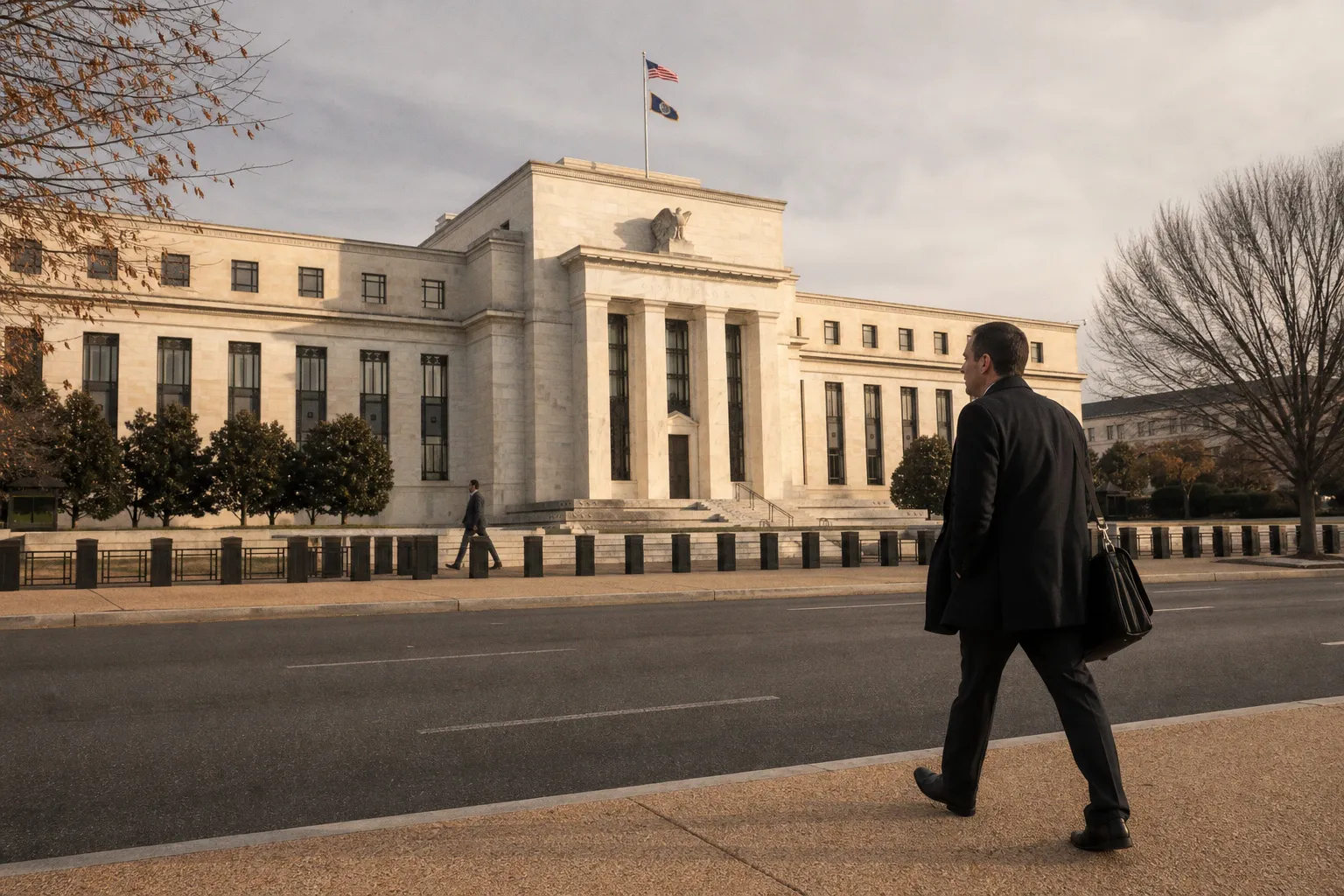
The signal beneath the signal
Forward guidance has functioned as a policy instrument, not merely a communication device, since the post-GFC era. When a central bank pulls back on explicit rate-path signaling, the default market assumption is hawkish — fewer promised cuts imply a higher terminal rate, P/E compression for duration-heavy equities, and widening credit spreads on the long end. The IMF's chief economist disputes that read. "Entirely appropriate" is not a neutral phrase; it explicitly decouples the guidance reduction from any tightening intent.
We process this as a narrative override. Multilateral cover compresses the policy-uncertainty premium and reduces the variance allocators must price into front-end yields. The mechanical effect: tighter realized vol on duration, weaker convexity hedging demand, and a flatter term-premium curve over the next several sessions. Order routing on rate products will likely shift toward smaller clip sizes as conviction bands narrow.
Capital flow implications
Rate-sensitive equity baskets — REITs, utilities, high-multiple growth names — historically absorb the brunt of guidance recalibrations. With institutional endorsement, three flows become probable:
- Reduced short positioning in long-duration ETFs (TLT, IEF) as cost-of-capital assumptions converge
- A pause in defensive rotation if terminal-rate uncertainty narrows materially
- Marginal re-leveraging in rate-sensitive sectors, with basis-point moves amplifying through high-beta names
These are conditional, not confirmed. We will track weekly ETF creation/redemption data, CFTC commitments of traders on Fed funds futures, and the MOVE index for volatility confirmation before upgrading conviction.
What to track
The hard data points that will validate or invalidate this thesis:
- FOMC minutes and subsequent Fed speeches for consistency with the IMF framing
- 10-year Treasury realized vol over five- and ten-session windows
- Spread compression between investment-grade and high-yield corporates
- Net inflows/outflows on duration ETFs in the next two reporting cycles
Verdict
Pass on the hawkish-pivot narrative. The IMF's read — and our stress-test framework — treats this as a calibration of the signal-to-noise ratio, not a regime change. For active allocators: tighten risk parameters on duration-heavy books, monitor realized vol before adding exposure, and let flow data, not headlines, drive repositioning. The verdict is data-dependent, which is precisely the point the IMF is making.
Other news
 AI and semiconductors drive a new resource race reshaping global economies
 Multinationals Driving Growth Amid Global Fragmentation in 2026 - News and Statistics
 Developed Market Equity Funds Set New Weekly Inflow Record
 Long semiconductors is the most crowded trade on record; Spain favoured to win World Cup